
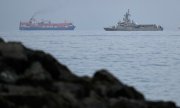
Strait of Hormuz blockade: should Nato help out?
US President Donald Trump has demanded that Nato member states take action to secure the Strait of Hormuz, warning that otherwise the future of the alliance looked "very bad". His appeal has found little support in Europe. EU Foreign Affairs Commissioner Kaja Kallas stressed that "This is not our war", and German Chancellor Friedrich Merz emphasised that the war with Iran was not a matter for Nato as a defence alliance. The media take stock.
Caution advised
The Guardian expresses understanding for the countries that refuse to provide the aid Trump has demanded:
“Many are cautious - and with good reason. Naval escorts would come under fire from Iran's drones, missiles and speedboats, as well as having to navigate mines. Participating navies would find themselves in an illegal war. The US could attempt to secure shipping through the strait alone, but doing so without its traditional allies would expose Washington's isolation. Europeans also have to consider the domestic reaction - a dilemma shared by Gulf nations caught between US alliances and public sentiment.”
Make a diplomatic counteroffer
It's time for a well-considered response, L'Echo advises:
“Given the immense risk, the effectiveness of such a deployment is far from guaranteed. ... The European public is not prepared to watch its marines risk their lives against Iranians who are willing to do anything to inflict maximum damage on global trade. But this does not prevent Europeans from committing to a long-term effort starting immediately. The Strait of Hormuz will one day need to be cleared, particularly through mine-clearing operations - an area in which Belgium excels. The response to Donald Trump must therefore be measured: Yes, we want to cooperate, but we will only act once the diplomatic channels are reopened.”
Fix the cracks now
It could pay off for Europe to help the US, Etelä-Suomen Sanomat believes:
“Now would be the perfect moment to give Trump a taste of his own medicine. It would be a real pleasure to tell the most powerful man in the world: You brought this on yourself! However, that would mean stooping to Trump's level. Instead, Europe should show how civilised nations behave. They help an ally in times of need. They don't turn the other cheek, but they can offer assistance in problem solving and provide support - both now and in the future. The rifts between Europe and the US might even heal as a result.”
Escorting a tanker isn't a declaration of war
It will be difficult for Merz to stick to his 'no', says Der Tagesspiegel:
“What is the protection of sea lanes? A classic task of international governance. ... Countries that export as much as Germany, and which depend on stable supply chains, can't simply assume that others will sort out the problems. Germany is already participating in missions to protect shipping. In the Red Sea there is a European naval operation against attacks by the Houthi militia. So Europe is protecting merchant ships there, and for good reasons. Why should that principle not also apply in the Strait of Hormuz? ... Escorting civilian tankers, acting as a deterrent presence, taking part in a multinational mission to secure an international waterway - these things don't mean entering the war.”
Passing the buck
Other states deploying ships in the strait wouldn't really make it secure, but they would then be sitting in the same boat as Trump, La Stampa writes:
“While a military intervention by other countries would certainly ease the pressure on the US Navy - which is busy intercepting Iranian missiles and drones in the Gulf - it wouldn't change the fundamental equation: the Strait of Hormuz would effectively remain closed. This is Iran's asymmetric advantage: although it's the weaker side in the war, that does not automatically make it the loser. So why has Trump asked European and Asian countries to intervene? Quite simply: to draw them into a conflict that is heading in the wrong direction, and thus to share the costs, consequences, and responsibility.”
Brutality destroying the international order
TVNet criticises Trump's brand of global politics:
“In Trump's view, the alliance is not a principle of collective security but a tool for making others foot the bill for his own adventures. This is exactly what US policy looks like: allies are blackmailed and aggressors are whitewashed. This is repugnant and unacceptable, because it normalises aggression. Russia can invade a neighbouring country, destroy cities, kill civilians, deport children, wreak havoc in the heart of Europe and yet still sit back down at the negotiating table because someone in Washington needs slightly lower oil prices - in this way the international order loses all meaning. Then only one rule applies: whoever is brutal and useful enough will be forgiven no matter what they do.”