
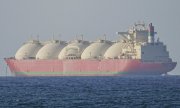
US blocks Strait of Hormuz
After the initial failure of peace talks with Iran, the US has begun its own blockade of the Strait of Hormuz. According to the US millitary, six merchant ships arriving from Iran have been forced to turn back within the first 24 hours. President Trump has said that a key reason for the blockade is to prevent transit tolls from falling into the hands of the regime in Tehran. What consequences could this provoke?
Only US citizens can save us
The US appears to be striving for dominance in the global oil market, writes deputy editor-in-chief Pietro Saccò in Avvenire:
“Perhaps it's time to ask ourselves what can save us from Washington’s greed for oil. ... The most concrete hope of resolving this situation currently comes from America itself, and more specifically its petrol stations, which are displaying prices of over four dollars per gallon, or roughly one dollar per litre. That may seem like not very much to us, but over there it's the highest it's been since 2022. This price is the first threat to Trump ahead of this November's mid-term elections; these prices remind American citizens that while the oil companies and energy traders may benefit from this oil dominance, they certainly do not.”
Maximum pressure can't replace strategy
Trump's leadership style is too simplistic for today's global political situation, writes Večernji list:
“It is becoming increasingly clear that Trump's policies, which often rely on his personal leadership style and sudden, sometimes impulsive decisions, are unable to keep up with the complexity of modern geopolitical relations. His 'maximum pressure' strategy makes sense when opponents are isolated or weaker, but in a world where China, Russia or regional powers are actively shaping events, such an approach hits up against its limits. Rhetorical escalation without a clear strategy can backfire and encourage opponents to test the boundaries more intensely.”
Crisis paving the way for renewables
The Hormuz debacle has given renewables a boost, author Carina Cockrell-Ferre explains on Facebook:
“Trump has accelerated the transition to renewable energy in a way that is scarcely measurable; it is no longer just an obsession of the Greens but an urgent necessity that impacts everyone financially, right here and now. ... The Strait of Hormuz will be reopened, but the whole affair will leave a bitter aftertaste. In the West and the East alike, it has become clear to practically everyone that we must seek alternatives, switch to renewable energy sources – and put an end to energy blackmailing! It's not so easy to do with renewables. They don't require tankers, straits, convoys, pipelines, etc.”
Eroding the bedrock of globalisation
The international order is under threat, writes El País:
“Spain's National Statistics Institute (INE) confirmed yesterday that inflation had risen to 3.4 percent in March, exceeding initial forecasts. … The figures highlight the damage already caused by the war in Iran. … Yet they do not reflect the – perhaps irreversible – impact of this conflict on the world order. Geopolitical tensions have called into question the already fragile international cooperation, and the blockade of the Strait of Hormuz threatens to put an end to the right of peaceful passage – the principle that facilitates 90 percent of global trade and forms the very bedrock of globalisation. It is here that the consequences of the arbitrary decision to destroy the pillars of the multilateral architecture are most visible.”
Danger of confrontation with Beijing
The Times warns:
“If America's blockading forces start to land on Chinese-crewed, Chinese-owned, China-bound but false-flagged tankers, then a deepening confrontation with Beijing is far more likely than big power Gulf co-operation. The potential for armed confrontation is real. China wants Iran as a stable oil supplier. And Beijing measures stability as a compliant regime able to withstand internal or external challenges from the US.”
Trump worried about losing dollar dominance
Trump is driven by fear about the future of the US currency, Corriere della Sera suspects:
“With every passing day, the war in the Gulf seems to be less and less about oil or the future of the regime in Tehran and more and more about the dollar – in particular its unchallenged role as the dominant currency in international transactions. ... But the outcome of the war and the order that emerges could erode the dominance of the US currency. ... The regime in Tehran has explicitly designed the toll [for tankers to pass through the strait] as a challenge to the dollar. Payments are – or were – only accepted in digital Chinese yuan or bitcoin. But not in stablecoins, which are backed by dollar reserves.”