
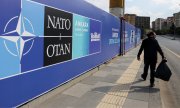
Nato summit in Ankara: a new role for Europe?
The leaders of the Nato member states will convene in Turkey on Tuesday and Wednesday for a summit of the defence alliance. A glance at the commentaries shows that in addition to addressing the future of Ukraine and its stance vis-à-vis Russia and in the war in Iran, the defence alliance is also expected to redefine the relationship between the US and Europe.
Start thinking about shared custody
The time has come for a mature discussion on mutual relationships, says De Morgen:
“It is in the interests of both the European Nato members and the US to establish at this summit exactly what Nato 3.0 should look like and who does what when it comes to the crunch. Let's stop giving the impression that there is still a unified, close alliance; instead, let us strive for an optimal long-distance relationship, with a clear timetable for a divorce settlement where necessary, and joint efforts in those areas where this is still possible.”
Those who pay more can demand more
El Periódico de Catalunya comments on how Europe's role in Nato has changed:
“The European Nato member states have increased their defence spending. By 2025, military spending by European countries had risen by 20 percent – far more than in China and three times as much as in Russia, despite the war in Ukraine. ... The European position has prevailed on two key issues: Ukraine and Iran. The Ankara summit must therefore result in an alliance with more European input, with a more multipolar character and with greater respect for the rules. Those who pay more can demand more.”
No time for passivity
EU correspondent Valérie de Graffenried calls in Le Temps for Europe to be more assertive:
“Is giving up all ambition in order to preserve a facade of unity really a viable strategy? Europe can certainly no longer hide its vulnerability in the face of Donald Trump's unpredictability, which regularly undermines transatlantic relations. And all too often, it gives the impression of merely passively accepting developments. Yet the real challenge for Nato is no longer to simply cope with Donald Trump but to demonstrate that its cohesion, credibility and deterrent capability do not depend on the whims of a single US president.”
Meloni an easy target
Italy's Prime Minister won't have an easy time at the the summit, Corriere della Sera explains:
“Giorgia Meloni faces a twofold and difficult challenge at the Nato summit. ... Like all European leaders, first and foremost she will have to deal with Donald Trump. Diplomats – particularly the Americans – are expecting the President's next solo appearance to be eccentric and reckless. He is likely to lash out at those allies who he says failed to support him in the conflict with Iran, while at the same time criticising those governments which in his view are still spending too little on defence. The government led by Meloni falls into both categories and is therefore – along with the Spanish government under Pedro Sánchez – particularly exposed to Trump's wrath.”
Kyiv needs more missile defence
One of Kyiv's key expectations for the Nato summit is that the decision will be taken to strengthen its defence capabilities against ballistic threats, 24tv.ua writes:
“It's no longer enough just to discuss new aid packages every few months – long-term solutions are needed. Joint arms production, licences to manufacture modern air defence systems, stepping up the production of Patriot missiles and new mechanisms for funding the defence industry – all this can help Ukraine not only to hold its ground in the war against the Russian aggressor, but also to inflict significant defeats on it and defend its own cities. The latest massive attack on the capital has shown that we have problems countering Russian ballistic missiles, proving that we cannot manage without support on that front.”