
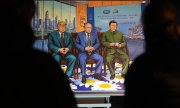
Xi, Trump, Putin: what can the trilateral summit achieve?
According to the US administration, Chinese leader Xi Jinping, US President Donald Trump and Russian President Vladimir Putin are to meet for the first time at a trilateral summit. The meeting is scheduled to take place on Thursday on the sidelines of the Asia-Pacific Economic Cooperation (APEC) forum in Shenzhen, China. Among other things, the leaders are expected to discuss a reduction of nuclear arsenals worldwide.
China at the centre of the world stage
Xi Jinping is embarking on a delicate balancing act, La Stampa observes:
“Donald Trump and Vladimir Putin will be standing by his side in Shenzhen – officially without discussing what China has deliberately left off the agenda. No mention of Ukraine or a deal. ... The first ever trilateral meeting of the leaders of the three major powers puts Beijing centre stage in global diplomacy without obliging it to resolve the world's crises. Xi is preparing to present himself as the great balancer of a disorder that his two heavyweight guests helped to create. ... Yet in Shenzhen he will need all his influence to remain at the centre of events and avoid becoming a pawn in someone else's game.”
Beijing no angel of peace
Columnist Matthew Syed warns against naivety in The Sunday Times:
“China has effectively knitted together a strategic alliance in which Iran supplies Russia with weapons, North Korea supplies Moscow with troops and Russia provides hydrocarbons and intelligence – while Xi pretends to be a 'neutral' actor concerned with 'rules' and 'peace'. ... As President Xi basks in the acclaim of a credulous world next week, I hope more than a few of us will be resisting the temptation to swoon at his 'polished' diplomacy and instead think of the stolen children of Ukraine, the thousands enduring genocide in Xinjiang and the countless victims of Iran's ayatollahs.”
Three's a crowd
Significant progress is unlikely, The Times puts in:
“China does not want to get dragged into discussions over Ukraine and is reluctant to agree cuts in its nuclear arsenal, a topic that Trump says he will bring up. Such summits are rare because leaders from opposing geopolitical blocs fear that in international diplomacy two is company, three's a crowd. Two-on-one pressure can leave the head of a superpower looking isolated. Unlike those at Yalta, the leaders this time appear to have taken the view that the risk of an impasse is greater than the likelihood of progress on major global matters.”
A boon for autocrats
Trump is keeping bad company, writes Público:
“Having been humiliated at home, it's only natural that the US President should seek to demonstrate his power on the international stage. The fact that this involves a photograph of two dictators attempting to create a new world order doesn't bother him, but it inspires contempt in any democrat. For Xi Jinping, and even more so for Vladimir Putin, standing side by side with the US on the international stage is always an triumph they will be keen to flaunt, and yet another reason for the European Union to be absent from this picture.”